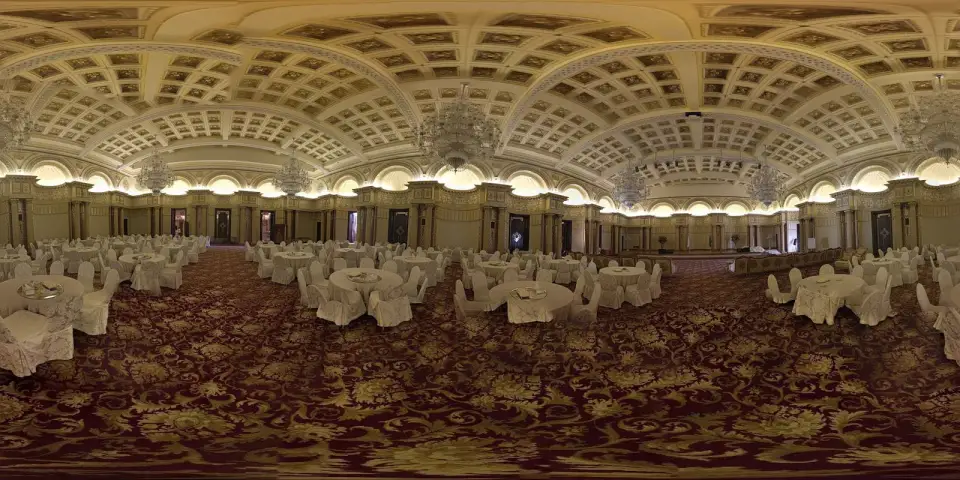
Palazzo Ballroom · Planning guides
Average Mahr in Saudi Arabia: The Figures, the Law and the Conversation
If you are marrying into a Saudi family, or helping someone who is, the mahr is the first number anyone asks about and the one least often written down. This guide collects what has actually been published, each figure with its source and date, explains what the Personal Status Law says, and describes how families usually reach an agreement.
Information, not legal or religious advice · every figure is attributed
At a glance
Saudi Arabia publishes no official average mahr. The most recent figure we found: a marriage officiant told Okaz newspaper in February 2026 that the average mahr today usually falls between SAR 50,000 and 60,000. A 2016 survey of marriage officiants by Al Watan newspaper put the range in Jeddah at SAR 30,000 to 80,000. Under the Personal Status Law the mahr belongs to the bride, and all or part of it may be deferred.
- Recent estimate (Okaz, 2026)
- SAR 50,000 to 60,000
- Jeddah range (Al Watan, 2016)
- SAR 30,000 to 80,000
- Who owns it
- The bride, by law
- Official average
- None published
Last updated:
What the Mahr Is, and What It Is Not
Newcomers often translate mahr as “dowry”, and the word misleads. In much of the world a dowry flows from the bride's family to the groom. A bride price is paid to the bride's father. The mahr is neither. It is a payment from the groom to the bride herself, it becomes her property, and nobody, her father included, can oblige her to spend it in any particular way.
Saudi law says this in so many words. The Personal Status Law defines the mahr as the property a man pays to a woman by reason of the marriage contract, and states that it belongs to the woman, who cannot be compelled to dispose of it. It is agreed between the families before the contract is signed, written into that contract by the officiant, and its prompt portion is normally paid before the couple begin married life.
Three related words come up in the same conversations:
- Milka (ملكة): the contract ceremony, often with its own party. From this point the couple are legally married.
- Shabka (شبكة): the jewellery set the groom gives the bride. Whether it counts towards the mahr is a family question, discussed below.
- Jihaz (جهاز): the bride's trousseau of clothes, perfume and personal items, which in many families is bought from the mahr.
How these fit into the whole sequence of a Saudi wedding, from the first family visit to the wedding night, is explained in our Saudi wedding guide.
What Has Been Published About the Average Mahr
Search for the average mahr in Saudi Arabia and the same numbers repeat from site to site with no indication of who said them. We could not find a mahr average published by the General Authority for Statistics or the Ministry of Justice. What follows is limited to figures printed by named newspapers, newest first:
| Figure | What it represents | Source and date |
|---|---|---|
| SAR 50,000 to 60,000 | A marriage officiant's estimate of the usual average today | Okaz, investigation on young men delaying marriage, 6 February 2026 |
| SAR 50,000 (first marriage) and 30,000 (previously married bride) | A proposed ceiling for the Makkah Region, not an observed average | Directive of the Emir of Makkah Region, as reported by Asharq Al-Awsat (18 August 2015) and Sayidaty (19 August 2015) |
| SAR 30,000 to 80,000 | Lowest and highest mahr reported in Jeddah | Al Watan survey with marriage officiants accredited by the Ministry of Justice, 17 September 2016 |
| SAR 20,000 to 100,000 | Al-Ahsa, the highest ceiling in the same survey | Same source |
For a sense of scale, SAR 50,000 to 60,000 is roughly USD 13,300 to 16,000 at the riyal's fixed rate of 3.75 to the dollar.
How to read these numbers
- The 2026 figure is an informed estimate, not a statistic. It comes from an officiant who writes marriage contracts, which makes it the closest thing to a current average in print, but it rests on no declared sample.
- The famous “50,000 and 30,000” began as a cap. Many websites present these as an official average or a legal limit. They come from a 2015 telegram from the Makkah Region emirate, which noted rising dowries among some families and asked governors to work with tribal elders on a dowry charter. It proposed those two ceilings. It was not a national law.
- The city survey is ten years old. We include it because it is the only published source we found that gives figures city by city with a clear method. Prices have moved since.
A March 2026 Arab News feature on rising wedding costs gives the human side. One bride-to-be told the paper that “fifty thousand riyals ($13,330) used to mean something different”; a 25-year-old woman said that “something like 70,000 riyals feels reasonable” given what everything else now costs. These are individual views rather than averages, but they explain why the old benchmark of 50,000 now feels smaller than it did.
Mahr in Jeddah and Other Saudi Cities
The only city-by-city survey we found was published by Al Watan on 17 September 2016, compiled with marriage officiants accredited by the Ministry of Justice. These are its ranges for the Hijaz, the western region that includes Jeddah, with a few other cities for comparison:
| City | Lowest reported | Highest reported |
|---|---|---|
| Jeddah | SAR 30,000 | SAR 80,000 |
| Makkah | SAR 15,000 | SAR 70,000 |
| Madinah | SAR 30,000 | SAR 50,000 |
| Yanbu | SAR 40,000 | SAR 50,000 |
| Al-Ahsa | SAR 20,000 | SAR 100,000 |
| Dammam | SAR 20,000 | SAR 60,000 |
| Abha | SAR 40,000 | SAR 60,000 |
| Tabuk | SAR 40,000 | SAR 60,000 |
Source: Al Watan, 17 September 2016. Riyadh and Taif were not included in the published survey, so we give no figure for them.
Jeddah had the highest ceiling of any Hijazi city in that survey, SAR 80,000 against 70,000 in Makkah and 50,000 in Madinah. A wide spread is what you would expect in a large port city whose families come from many regions and backgrounds, each with its own custom. For that reason the useful question is rarely “what is the mahr in Jeddah?” and almost always “what have recent weddings in these two families involved?”
Jeddah is a governorate of the Makkah Region, so the 2015 initiative covered it. We found nothing to show that the proposed ceilings were ever applied as a rule, and the figures published since, in 2016 and in 2026, reach or exceed them.
What the Personal Status Law Says
Saudi Arabia codified family law in the Personal Status Law, issued by Royal Decree M/73 dated 6/8/1443 AH and in force since June 2022. Its articles on the mahr are short. In plain English:
| Article | What it says | In practice |
|---|---|---|
| 36 | The mahr is the property a man pays a woman by reason of the marriage contract | It is paid to the bride, not to her parents |
| 37 | Anything that can validly be regarded as property can be a mahr | Cash is usual, but gold or other assets are possible |
| 38 | The mahr belongs to the woman, who cannot be compelled to dispose of it | No one can require her to spend it on the trousseau or the party |
| 39 | The contract may defer all or part of the mahr | The basis of the prompt and deferred portions |
| 40 | The mahr is owed under a valid contract and confirmed in full by consummation, seclusion or the death of either spouse | A woman divorced before consummation receives half the stated mahr |
| 41 | A “fair mahr” (mahr al-mithl) applies if none was named, it was excluded, or the named one is invalid | A contract silent on the mahr does not cancel the right to it |
| 43 | The wife may decline to move into the marital home until she receives the prompt mahr, and the husband provides suitable housing | The bride may ask for the prompt portion before the wedding; housing is the husband's responsibility |
Prompt and deferred mahr
The prompt mahr (muqaddam or mu'ajjal) is handed over at the contract or before the wedding. The deferred mahr (mu'akhkhar) remains a debt owed by the husband until a later date. Article 39 sets out when a deferred amount falls due: on the date stated, if the contract names one; immediately, if the date is left vague; and on final separation or the death of either spouse, if no time is stated at all. Where the contract mentions no deferral and no delivery date, the mahr is due on request.
Families differ. Some write the whole mahr as prompt; others defer part of it. Whatever you agree, make sure both figures are written into the contract, because an unwritten understanding is hard to prove years later.
This is a plain-language summary for orientation. It is not legal advice and it is not a religious ruling. For a particular situation, consult the full text of the law, the officiant, a licensed lawyer or the competent court; religious questions about the mahr are for qualified scholars, among whom views can differ.
What the Mahr Usually Pays For
Legally the money is the bride's to use as she wishes. Socially, many families expect her to prepare for married life from it, and the details vary from one household to the next. These are the items that usually come up, with the question that settles each one:
| Item | How families differ | Ask before the contract |
|---|---|---|
| Shabka (gold set and ring) | Part of the mahr in some families, a separate gift from the groom in others | Does the shabka come out of the mahr or on top of it? |
| Trousseau: clothes, perfume, bags, personal items | Often bought from the mahr, at the bride's discretion | How much will she set aside, and what does she keep? |
| Wedding dress, hair and make-up | From the mahr, or paid by the bride's family | Who pays, and does it count against the mahr? |
| The women's reception | Paid by the groom's family in some cases, shared in others | Who books the hall, and who pays for each section? |
| Home and furniture | Article 43 places suitable housing on the husband | What will the groom have ready before the wedding? |
Is the shabka a gift or part of the mahr?
This matters most when an engagement ends. Article 3 of the law treats anything given during the engagement as a gift, unless the suitor declares that it is mahr or local custom treats it as such. Article 5 deals with money handed over before the contract as mahr when the marriage does not go ahead: the suitor or his heirs may recover it, or its equivalent or value, and if the fiancée has already spent it on items for the marriage, the law gives her a choice in certain cases between returning the money and handing over what she bought. The practical lesson is simple: when the shabka is presented, say clearly whether it is a gift or part of the mahr, and put it in a message between the families.
How Families Agree the Amount
In most households the groom's father, or the senior man of his family, speaks with the bride's guardian. In many families the mothers have talked first, so that by the time the men sit down the numbers are already close. If you are new to the custom, these six steps keep the conversation smooth:
- Learn the families' own benchmark. Ask, discreetly, what recent weddings on both sides involved. That reference will shape expectations far more than any national figure.
- Hear the bride. The mahr is hers by law. She should know the figure before it is agreed, and she may settle for less than her family proposes or ask for what she considers right.
- Define what it covers. “All-inclusive” means different things to different families. Name the items: shabka, trousseau, dress, a share of the party.
- Agree the prompt and deferred split. How much is paid before the wedding, how much is deferred, and until when. If nothing is deferred, say so.
- Check the contract. The officiant records the mahr. Read the amount, the prompt portion and any deferred portion before anyone signs.
- Pay traceably. A bank transfer into the bride's own account, or a signed receipt, protects everyone, especially if part is paid before the contract.
Two habits help. Keep the mahr and the party separate, because the mahr is the bride's money and the party is one night's expense, and mixing them invites each side to count differently. And speak in figures rather than hints: “the same as at your cousin's wedding” can mean three different numbers. Many people cite the saying of the Prophet that the best mahr is the easiest, as an encouragement to moderation; the right amount for a given couple remains a matter for the two families.
Is there a legal maximum?
We found no upper or lower limit in the mahr articles of the Personal Status Law. The ceilings that appear in the news are local social initiatives: the 2015 Makkah Region proposal of SAR 50,000 and 30,000, and charters agreed by tribes in their own areas. They bind those who accept them, not the country as a whole.
Notes for Expatriate and Mixed Couples
- The amount follows the family, not your passport. If the bride's family is Saudi, their custom sets the expectation. A token mahr that is normal in some communities abroad may come across very differently here. Ask a trusted relative to explain the family's practice before the first formal meeting.
- The paperwork is separate from the party. The marriage contract is a legal process handled by the officiant and the courts, and for foreign nationals usually also involves their embassy. Start it early and follow official guidance. A wedding venue hosts the celebration and plays no part in it.
- Who pays for what is not the Western split. The idea that the bride's family pays for the wedding does not carry over. The mahr comes from the groom, and the cost of each reception is agreed between the families.
- Talk in riyals. Agree the figure in Saudi riyals and keep the written record in riyals, even if the money comes from an account abroad, so the amount in the contract is never in doubt.
Where the Mahr Sits in the Wedding Budget
The mahr is not part of the celebration budget, and it is settled first, because everything else is paid from what remains. A sensible order for the large items:
- The mahr, plus the shabka if it is separate.
- The home and furniture, the husband's responsibility under Article 43.
- The milka party, if it is held on its own evening.
- The wedding night: venue, catering, bridal stage, photography, dress and the rest.
- The honeymoon.
The first three are set by agreement between the families. The wedding night is driven mainly by the guest list. The published figures for each heading, with their sources, are on wedding cost in Saudi Arabia. If the mahr leaves less for the party than you hoped, the practical ways to bring the celebration down are on cheap wedding halls in Jeddah, including booking a single hall for about 100 guests. Palazzo pricing is available on request and depends on your event date and number of attendees, so ask for the figure early and plan around a real number.
Marriage loans
Arab News, on 30 March 2026, quoted a family lawyer pointing to interest-free government marriage loans of up to SAR 60,000. Eligibility, amounts and terms change, so check them directly with the Social Development Bank before building them into a plan.
Frequently Asked Questions
What is the average mahr in Saudi Arabia?
No official average is published. A marriage officiant told Okaz in February 2026 that the average today usually falls between SAR 50,000 and 60,000, with wide variation between families and regions.
How much is the mahr in Jeddah?
Al Watan's survey of marriage officiants, published in September 2016, reported a range of SAR 30,000 to 80,000 in Jeddah. We have not found a more recent Jeddah-specific figure from a named source.
Is the mahr the same as a dowry?
Not in the usual sense. A dowry often comes from the bride's family; the mahr is paid by the groom to the bride and, under Article 38 of the Personal Status Law, it belongs to her.
What is the difference between prompt and deferred mahr?
The prompt portion is paid at the contract or before the wedding. The deferred portion stays a debt owed by the husband; if no date is stated, Article 39 makes it due on final separation or the death of either spouse.
Is there a maximum mahr in Saudi law?
We found no limit in the mahr articles of the Personal Status Law. A 2015 Makkah Region initiative proposed ceilings of SAR 50,000 and 30,000, but as a social charter rather than a national rule.
Does the shabka count as part of the mahr?
Only if the families agree it does. Article 3 treats engagement gifts as gifts unless the suitor declares them to be mahr or custom treats them so, which is why it is worth saying clearly when the shabka is given.
The Mahr Is Agreed. Now the Celebration
Send the number of men and women you expect and the likely month. You receive a written quote for the milka or the wedding night, so the rest of the budget rests on a real figure.
Location & Contact
Opening hours
Daily, 3 pm to 11 pm